
The art of the undressed
How removing the wardrobe forced me to rethink the power of trust and collaboration in my photography.
Jan 22, 2026

Retired Firefighter/EMT | Professional Photographer | AANR Member & Young Adult & Diversity Council Member | 🏳️🌈👬🏼 Gay & Happily Married | Naturist | Pronouns: He/Him/His
Have you ever wondered why some portraits feel like they are looking right through you, while others feel like they are hiding behind a mask? For years, I believed that the “soul” of a photograph was captured in the eyes or the lighting, but it wasn’t until I began working with nudity that I realized the most vital element of a portrait is actually the invisible space between the photographer and the subject. My goal is that you will understand how stripping away fabric actually adds layers of complexity to the creative process and how these lessons in trust and consent can transform any human interaction.
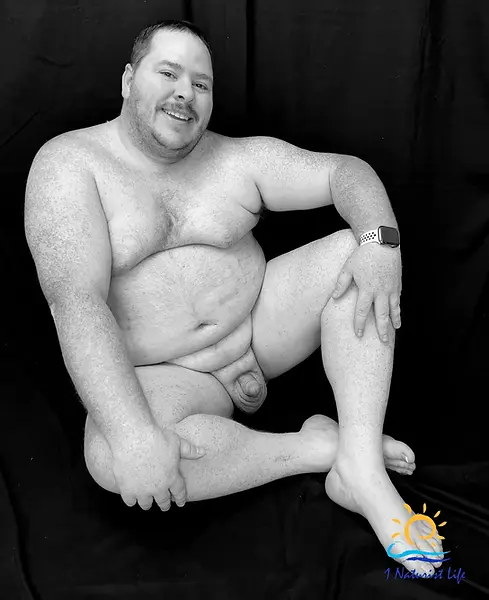
My first self portrait from several years ago.
The vulnerability of a shared space
When a subject removes their clothes, the traditional power dynamic of a photo shoot immediately shifts. In a standard portrait session, clothing acts as a shield or a costume that tells a specific story. It provides a layer of protection for the subject. Without it, that protection vanishes. This vulnerability is not a weakness; it is a profound form of honesty.
As a photographer, I realized quickly that I could not remain a detached observer while asking someone else to be so exposed. To create a safe environment, I had to offer a different kind of vulnerability: my own professional transparency. Trust in nude photography is not something you “get” from a subject; it is something you build together through constant communication. It starts long before the camera is even out of the bag. It begins with discussing boundaries, aesthetic goals, and the intended use of the images. When the subject knows exactly what to expect, the anxiety of the unknown is replaced by a shared sense of purpose.
Moving from capture to creative collaboration
The language we often use in photography can be surprisingly aggressive. We talk about “shooting” a subject or “capturing” a look. In the context of nudity, this predatory language feels especially outdated and inaccurate. My approach shifted from “taking” a photo to “making” one alongside the person in front of the lens.
In this collaborative model, the subject is not a passive object to be arranged. They are an active participant in the visual storytelling. We discuss the geometry of the body, the way light hits skin, and the emotions we want to evoke. Because there are no clothes to provide context, we rely on movement and expression to convey meaning. This requires the subject to be fully present and the photographer to be an active listener. When the person being photographed feels like an architect of the image, the resulting work is always more authentic. It stops being a photo of a naked body and starts being a portrait of a person who happens to be nude.
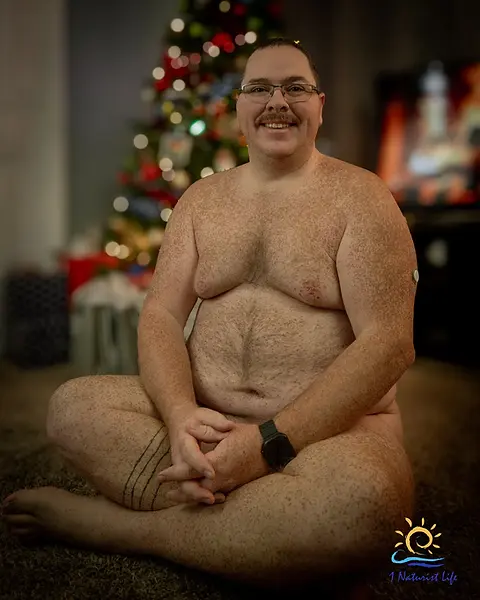
My latest self portrait from Christmas 2025.
The necessity of ongoing informed consent
In the modern era, consent is the most critical component of any creative practice. In my work, I have learned that consent is not a one-time signature on a model release form. It is a living, breathing dialogue that continues throughout the entire session. It must be specific and reversible.
This means checking in frequently. I ask if a certain pose feels comfortable or if they need a break to put on a robe and reset. I ensure they have the right to veto any image they don’t feel represents them well. This level of respect for personal agency does not stifle creativity. Instead, it expands it. When a subject knows their boundaries are sacrosanct, they feel more confident to experiment and push the creative limits of the session. We are no longer worrying about what might go wrong, which allows us to focus entirely on what is going right.
Ultimately, photographing people without clothes has taught me that the most beautiful part of a person isn’t their physical form, but their willingness to be seen. It is a lesson in humanity that applies far beyond the studio walls.
Young people and naturism
Sociology, "the scientific study of human societies, social behavior, and institutions," helps explain how naturism is perceived by young people (especially)

Jan 12, 2026
A key observation sociology offers is that human behavior tends to be shaped by observing what other humans are doing. The tendency is powerful among older teenagers and young adults. Children and young teens learn “proper” social behavior initially from their parents and teachers. However, in the later teen years, the influence of peers becomes stronger. This influence may last into middle age (at least).
These days, most naturists tend to be older, like 50 or more. Most of them, regardless of age, probably began participating in naturism due to peer influencess - especially male/female influences - which may be direct or indirect. The strength of peer influence - or lack of it - is probably the main reason that interest in naturism is declining in most countries (if it exists at all), as older participants age out. This is why contemporary efforts to interest young people in naturism and learn how and why to participate generally don’t work. (NB: generalizations like this don’t always apply.)

There are various reasons for this, and we’ll consider some of them here. But one thing is clear: simply trying to explain to young people how and why they should engage in naturism is seldom successful.
Naturism (or “Nudism” as it was earlier known) is considered to have its U.S. origin with the arrival of Kurt Barthel from Germany in 1929. There’s a lot of history behind that, far too much to even summarize here. But the most salient fact is that it was originally engaged in mainly by members of the generations now called the “Greatest Generation” and the “Silent Generation.”
“Social nudity” is an even more general term that encompasses nudity mostly in private homes, only within a nuclear or extended family, or with like-minded friends. But organized social nudity, where most participants are naked, was at first mostly practiced quite secretively only on private properties in rural areas. The first actual U.S. naturist camps or resorts appeared in the mid-1930s. A small number of them still exist. Of course, very few people from those early generations are still around.
For our purposes, let’s begin by looking at how and why members of the post-war “Baby-boom” generation are still (generally) the most frequent participants in naturism, especially in the U.S. That explains much of why interest in naturism is lacking among younger people. (Although I dislike the derisive “Boomer” epithet, it’s the most convenient term to use.)
“Boomers” are mostly the children of male parents who were directly or indirectly involved in World War II. (The female parents typically remained home.) Quite simply, when those young (30s or less) men were free of involvement in the war, they usually married and started families (if they hadn’t already). During the war, they were accustomed to open showers in the barracks, as were men who remained in the military.
Even before the war, nudity for older school children was normal in gender-separated locker rooms and open showers after gym classes, and perhaps in swimming pools of schools that had one. This was generally true for both boys and girls. That was also true in YMCA pools until the late 1960s, but decreasingly afterwards. Since YMCAs began admitting girls, women, and entire families to their facilities, pool nudity became infeasible. Nude pool use had ended by the 1980s, although gender-specific nudity in locker rooms and showers was normal much longer.
Generally speaking, this trend resulted from concerns over sexual abuse and potential legal liabilities in schools, YMCAs, and other public facilities. The basic concerns weren’t unreasonable, and increasing caution was the trend. However, it was the Boomer and earlier generations that initially experienced the fewest cautions regarding nudity. To many young men, nudity in appropriate venues was basically “normal” and not any big deal. To some extent, the same may be true of their girlfriends and spouses. In short, nudity in a few appropriate public circumstances was expected and “normal.”
Even before the 1960s, open nudity in the form of “skinny-dipping” in the U.S. (and elsewhere) had been common and entirely normal for much longer. So, the Tom Sawyers and Huckleberry Finns certainly considered their naked enjoyment of natural pools, hot springs, and streams not problematic at all.
In 1981, Lee Baxandall (who founded The Naturist Society (TNS)) published the 1st edition of his “Nude Beaches and Recreation”. The book listed about 160 skinny-dipping places in just the U.S. alone - not including sandy beaches on the ocean or large lakes. And Baxandall certainly must have missed numerous lesser-known places besides.
An updated edition of that guidebook was published in 2008 (the year of Baxandall’s death) and renamed “The World’s Best Nude Beaches.” It lists fewer than 25 U.S. places (besides beaches and resorts) similar to those in the 1st edition. Most of the listings are established naturist resorts, bed-and-breakfasts, clothing-optional beaches on lakes or the ocean, etc., as in the 1st edition. Some of the skinny-dipping places listed in the 1st edition are still used. Many guides to U.S. swimming holes still exist from various publishers. Such guides can be found on Amazon by a book request for “swimming holes.”
The problem is that most skinny-dipping places are known and used (if at all) mainly by locals in rural areas, with young people often in the minority - especially as many are unaware of the places or even the guidebooks. Established clothing-optional beaches in the U.S. are few and far between, and that’s also true of the dwindling number of established naturist parks and resorts. So the cost of travel to any of the “free” possibilities is a significant deterrent for young people, who may struggle to pay the rent where they live, especially if they already have small children. Affordability, of course, is usually an even larger problem with the parks and resorts.
All the above, not only affordability, just set the stage for the important question: What are the factors that directly deter the participation of young people (below the age of 50, say)?
The first factor is the continual disappearance of infrastructure. In Southern California alone, there is now exactly one traditional and healthy naturist resort: Glen Eden, which is about an hour’s drive from central Los Angeles. That it survives at all is because it’s member-owned. It’s not especially affordable or welcoming to young people. The 1995 edition of Baxandall’s guide lists twelve such establishments (though some are more like hotels than full-fledged resorts). That is a decline in numbers of nearly 92%. On the other hand, in Northern California, the same three establishments - Lupin (one of the oldest in the country), Laguna del Sol, and Sequoians - are still alive and (reasonably) well. (Go figure.) The statistics for resorts in the rest of the country are somewhere between the extremes in California.
A substantial majority of visitors to any of California’s resorts (and those in the other 49 States) are over 50. Although most are welcoming to younger visitors, the age difference and expenses are definite deterrents. That leaves the next 3 generations younger than Boomers - Zoomers, Millennials, and (a few) Generation X - as people younger than 50. That’s quite a lot of adults. The age difference really shouldn’t matter. But of course it does. Somehow, naturists need to figure out how to appeal to these younger folks. And doing that requires understanding the deterrents felt by the under-50s that extend beyond age differences.
The most likely deterrent is women’s concerns about sexual harassment and abuse. Those concerns have been significant and increasing for many years, after the free-spirited “hippie” days of the 1960s and 70s. That was a time when many women, as well as men, began visiting nude beaches and enjoyed occasional nudity on some college campuses. Nude bathing and sun-tanning at Lake Lagunita on the Stanford University campus around 1980, for example, was quite common and enjoyed equally by men and women. Even a few local teenagers participated, although the administration eventually fenced in the area to keep the teens out. (Lagunita is now mostly dry and no longer swimmable.)
Some colleges and universities had a few housing facilities that were “clothing-optional”, partly or entirely. Another aspect of that time was that newsstands and book stores on or near campuses often carried a selection of nudist magazines (which proliferated back then). Now, of course, both nudist magazines and newsstands are all but extinct. As a result, less information on naturism was available for a while before the Internet came along strongly.
Many photographs taken at nude beaches from the 60s and 70s document about as many clothes-free women as men. During that period, women seemed generally as comfortable with nudity as men - at naturist parks and resorts and some college campuses, as well as nude beaches. In a much more specific example, a few young men and women lived mostly naked in “communes”, such as Taylor Camp on the north shore of the island of Kauai. During its brief heyday from 1969 to the final evictions in 1977, the camp had at most about 120 occupants. This was just another small aspect of the “hippie” period.
Although naturist magazines mostly disappeared from availability, a few early electronic services, such as CompuServe, began to provide naturist information and discussion (which magazines couldn’t offer). But they reached relatively few people. The rise of the Internet and the use of personal computers were more helpful by 2000. Good information via blogs and social media appeared slowly on services like Blogger, WordPress, and Tumblr. That such services were used more by young people than older naturists was good.
Unfortunately, since the early 1980s, female participation in naturism has declined at an increasing rate - beginning near the dividing line between Generation X and the Millennials in 1981. This is almost certainly a result of women’s concerns about sexual harassment and abuse. It’s undeniable that women have typically been treated with less respect than men for most of recorded history, and the sexual issues are only part of the story. That’s the main thing, despite occasional intervals of equality. For naturism to be healthy and thrive, women must have no reason to fear participation, whether it’s in clubs and resorts, nude beaches, or anywhere else that genuine naturism is practiced.
The decline of female participation directly reduces the number of active naturists. Consequently, there are fewer people visiting nude beaches and other naturist places. It also discourages male participation. And those factors lead directly to younger people’s lack of interest in naturism. This is almost certainly the main reason that naturism in general has failed to thrive in the past few decades.
There certainly are other factors. (The workings of human societies are inevitably complicated.) For instance, there obviously are deeply ingrained beliefs that nudity itself is inherently improper, sinful, offensive, or immoral. Naturists must necessarily disbelieve those fallacies, but changing others’ minds is difficult.
But let’s get back to the main issue, which is that young people of the past two or three generations are just significantly less interested in naturism than those of previous generations. That has to change. Various aspects of the problem need to be addressed, and gender issues are simply near the top of the list, but hardly alone.
Currently active naturists, despite most being on the older side, are the ones who need to address the issues seriously. New ideas must be explored. How about if naturists encourage younger family members, relatives, or friends to accompany them while visiting naturist parks, nude beaches, skinny-dipping places, or places to hike or camp? You know, things that naturists typically enjoy. (Be sure it’s understood they needn’t undress if they don’t want to.)
But those places are almost too obvious. There are many possibilities, which may be even more inviting to young people than those most obvious ones. Some things, you know, that involve nudity, might naturally appeal to a younger person, can be done in a day or a weekend, and don’t require acquired skills. Some examples:
-
Body painting
-
Hot air balloon rides
-
Several days at a lake on a rental houseboat
-
Bungee jumping
-
River rafting or canoe trips
-
Art or photography classes with nude models
-
Landscape or wildlife photography
-
Most such things require cooperation with one or more people who aren’t fazed by nudity and have appropriate experience and/or equipment. There are other possibilities that may require some physical fitness or previous skills, such as rock climbing. But if they’re within your own abilities and those of whoever you bring with you, why not? The general idea is: if the activity is possible for yourself and whoever accompanies you, then try it naked.
Nude protester halts traffic during anti‑ICE demonstrations in Los Angeles
An unclaimed act of naked defiance joins a growing wave of global unrest

The Bare Truth: A Catholic Perspective on Nudity
Christians are getting it wrong when it comes to nudity. My piece dives into the taboo subject. It explores the misconceptions and benefits of this activity, and why nudity needs to be de stigmatized.

Supporting Naturist Creators
Why I Became a Patron of Naked, Nudists, and Naturists
To make naturism thrive and develop, we need to support naturist creators. I support many nudist and naturist creators by subscribing to their services, purchasing their products, or becoming patron. Last week, I became a patron of Naked, Nudists, and Naturists (NNN) on Patreon. This platform, which is the official podcast of the American Association for Nude Recreation, is dedicated to celebrating and promoting naturism through engaging content and interviews. By supporting them, I believe we can amplify the voices of creators who are passionate about nudism and naturism.
When One of Us Doesn’t Feel Comfortable in Our Skin
By ournaturistlife November 19, 2025
The Quiet, Honest Moments Naturist Couples Don’t Talk About
There’s a comforting myth people like to believe about naturists: that once you choose to live nude, your body confidence becomes permanent. It’s as if the moment the clothes come off, every insecurity you’ve ever carried simply dissolves. To the outside world, naturist life looks effortless, a state of constant comfort, constant ease, and constant self-acceptance.
But the truth is far more human, and far more tender. We are not finished products. We don’t have all the answers. We are still learning how to navigate these moments together, the sudden hesitations, the wavering confidence, the days when our bodies feel unfamiliar, and the quiet emotional shifts that naturism makes impossible to hide.
If anything, naturism hasn’t removed insecurity; it has made us more honest about it. So, what do we do when one of us doesn’t feel comfortable in our skin?
To be honest, we’re still figuring out how to meet each other gently in those moments.

People See the Photos, Not the Moments Before
When people see our photos, especially the artistic ones, they see the final result. They see Corin looking radiant and at ease, the light falling beautifully, the setting serene. What they don’t see is how many of those moments almost didn’t happen. They don’t see the times when we set everything up, the space ready and the inspiration alive, only to pause because something inside doesn’t feel aligned. They certainly don’t see the days when we close the camera bag without ever using it.
Although Corin appears confident in the images we share, there are days when she isn’t. Sometimes the confidence arrives fully formed; sometimes it doesn’t show up at all. And the very same is true for me. My insecurities may look different, but they’re no less real. I have days when I don’t feel grounded in my own body, or when my reflection catches me at an angle that stirs old insecurities. Naturism doesn’t prevent those moments; it simply removes the layers that help us hide them.
These invisible pauses, the quiet decisions to stop, to wait, or to try another time, form the emotional heartbeat behind the photos. They are the part no stranger sees.

Naturism Makes Us Honest With Each Other
One of the most unexpected lessons naturism has taught us is that insecurity doesn’t disappear; it simply becomes more transparent. When you remove clothing, you remove the easy ways of managing discomfort. There are no flattering angles created by fabric, no strategic shapes of clothing to offer emotional safety. Everything you feel, physically or emotionally, comes through the moment you stand bare.
Yet this vulnerability has brought a strange kind of closeness. Confidence and discomfort become mutual experiences that we navigate together. When one of us is struggling, it shows in subtle ways: a shift in posture, a quiet pause, a slight hesitation that wouldn’t be noticeable to anyone except each other. Because naturism makes hiding impossible, it has encouraged us to grow more attentive and more compassionate.
Being naturists hasn’t made us immune to insecurity; it has simply made us better at acknowledging it.
Why We Judge Ourselves So Harshly
Sometimes we pause and wonder why these uncomfortable moments happen so easily in the first place. Why does one angle in a mirror have the power to unravel us, or why does a small shift in lighting suddenly make us question the bodies we’ve lived in for decades? It’s not that naturism creates these feelings. They were planted long before. Self-judgment is something most of us absorbed from society long before we ever considered stepping into a naturist life.
We grew up in a world that teaches us that our worth is tied to how we look. Bodies are measured, compared, commented on, and categorized as if they are public property. Every magazine cover, every advertisement, every storyline in movies and television reinforces the idea that there are right bodies and wrong bodies, acceptable flaws and unacceptable ones. Even when we believe we’ve outgrown those pressures, the emotional weight of them stays lodged deep inside.
Naturism challenges those beliefs, but it doesn’t erase them. We can spend years embracing our bodies and still have moments where an old script suddenly plays in our heads, telling us we should look younger or smoother, or that aging needs to be hidden, or that real bodies require apologies. These ideas were sewn into us long before we undressed in front of others. So naturally, they surface from time to time, often without warning.
When we stand together in our naturist lives, we’re not just shedding clothing. We’re shedding decades of conditioning and judgment, and that is not a single act. It is an ongoing process. Some days we feel free from it, as if the world’s expectations slide effortlessly off our shoulders. Other days those expectations cling tightly, whispering that maybe we are not enough in the shape we’re in. Those are the days we realize we’re still unlearning. We’re still reclaiming. We’re still doing the emotional labour of teaching ourselves to see our bodies through our own eyes instead of society’s.

The Difference Between Not Being Happy With Our Bodies and Being Ashamed of Them
We’ve also learned there is a meaningful difference between not being happy with your body and being ashamed of it, and understanding that difference has softened so many of the emotions we once carried quietly. Not being happy with your body is natural. It’s the ebb and flow of living in a body that changes from one day to the next. There are mornings when nothing feels quite right, or evenings when a passing reflection surprises you in a way you don’t enjoy. These moments are temporary. They’re emotional weather patterns, drifting in and drifting out.
Shame is something else entirely. Shame is deeper. Shame is learned. Shame is the voice we inherited from a world that judged us long before we learned how to think for ourselves. It tells us that something about our body makes us unworthy or unacceptable. Shame convinces us that we are the problem, not the culture that taught us to measure ourselves.
We’ve walked this path before in some of our other writing, especially in Defiant Love: Our Marriage, Our Naturism, Our Rebellion and We Left Shame Behind… and We’re Not Going Back! Those reflections explored how shame embeds itself in us, and how naturism became our way of rewriting a story the world tried to write for us. This new moment in our journey connects back to those ideas, because shame rarely disappears on its own. It needs to be unlearned and gently released.
Naturism helps with that, but it doesn’t magically erase the old scripts. It simply makes room for truth to stand beside them. Most of our hard days aren’t about shame; they’re about temporary discomfort. But when shame does surface, naturism gives us the emotional space to see it for what it is, and being together gives us the support to move through it rather than bury it.
Supporting Each Other Without Trying to “Fix It”
One of the most important things we’ve learned, and are still learning, is that you cannot reassure someone out of discomfort. Even the most loving words, such as “You look amazing,” or “There’s nothing to worry about,” don’t always reach the place where insecurity lives. That is not because the words aren’t true, but because discomfort isn’t logical. It’s emotional.
When one of us is having an uncomfortable day, what helps isn’t convincing the other person to feel differently. What helps is acceptance. Space. Gentleness. What helps is saying, “It’s okay, we don’t have to do this today,” and meaning it. What helps is choosing connection over productivity, and emotional truth over expectations.
The kindness isn’t in pushing through the discomfort.
The kindness is in not needing to.
Sometimes we simply sit together and let the moment be what it is. Sometimes we shift plans entirely. Sometimes we take the pressure away and let the day unfold without a camera, without an agenda, and without the expectation that confidence will be there on command.
We’ve come to understand that our naturist life doesn’t require constant bravery; it requires mutual grace.

The Days After Matter Just as Much
What people rarely see is the way confidence quietly returns. Sometimes it happens the next day; sometimes later, but it always finds its way back. A night’s rest, a small shift in mood, a moment of reconnection, and suddenly the body that felt unfamiliar begins to feel like home again. The light seems softer. The air feels easier. And we find ourselves stepping into the moment with a sense of natural ease that wasn’t possible the day before.
Often, some of our favorite photos are taken after a day we almost gave up. Not because the pictures are perfect, but because they’re real.
They’re honest. They are the result of respecting each other’s boundaries rather than ignoring them.
Off days don’t ruin anything. If anything, they prepare us for the most authentic ones.
It’s Okay to Feel This Way
If there’s one thing we want people to take from all of this, it’s that these feelings are normal. It’s okay to have days when you don’t feel comfortable in your own body. It’s okay to question yourself, hesitate, or wonder why confidence seems to come and go. You don’t have to love every inch of your body to enjoy naturism, and you certainly don’t have to wait until you reach some mythical level of perfect body acceptance before trying it.
Somewhere along the way, naturists picked up this unspoken expectation that we’re supposed to be past all of this. That choosing nudity means we’ve evolved beyond insecurity. That we’ve solved something internal that others are still working on. That because we accept other people’s bodies so easily, we must accept our own with the same gentleness.
But that isn’t how it works. Not for us, and not for most people.
Naturism doesn’t require you to already feel confident. It doesn’t demand that you’ve unlearned every message society drilled into you about your supposed flaws. And it doesn’t ask you to pretend you’re immune to all the feelings you spent a lifetime developing. You can’t undo years of self-criticism overnight. You can’t erase decades of being taught to see your imperfections first. And you shouldn’t feel like a failure for having moments where those old messages still echo louder than you’d like.
Trying naturism… or continuing with it… does not mean you’ve perfected self-love. It just means you’re willing to show up anyway. You’re willing to learn. You’re willing to see what might change when you stop hiding from yourself. And sometimes, that act alone is more transformative than any amount of confidence you think you’re supposed to have.
If you’re reading this and you’ve ever felt like you weren’t “naturist enough” because of your insecurities, we hope this reassures you: you already belong. You don’t need to be fully comfortable with your body to experience naturism. You just need to be willing to be kind to yourself while you figure it out.
We are still figuring it out too.
Naturism Isn’t About Perfection, It’s About Presence
Confidence is not a steady flame. It flickers, it dips, and it reignites. Naturism doesn’t grant us mastery over that cycle; it simply teaches us to observe it, accept it, and support each other through it. We’ve learned that naturism isn’t about being comfortable all the time; it’s about being present with each other even when we’re not.
The quieter moments, the ones where we pause or change plans or simply stand beside one another without expectation, have become some of the most meaningful of our entire journey. They remind us that naturism is not a performance of confidence. It’s a practice of honesty. It’s an ongoing study in vulnerability, patience, and emotional truth.
And in those moments, even when one of us doesn’t feel comfortable in our skin, we’re reminded of what truly matters: we’re still learning how to navigate these moments together. We’re still growing. We’re still discovering new layers of each other. We’re still deepening the trust that naturism allowed in the first place.
Because at the end of the day, the most meaningful part of naturism isn’t the confidence.
It’s the connection.

By Greg Martin0, 2 JAN 2026
In search of the historic tidal pools in Cornwall which miners created using dynamite
Wild swimming in Cornwall is becoming increasingly popular - albeit maybe less so at this time of year.
As well as diving into the open water of the sea, bathers are taking the plunge at the numerous tidal pools that can be found dotted around the Cornish coastline.
Of course, wild swimming is nothing new, and it will come as no surprise that people have been enjoying the safe bathing of Cornwall’s tidal sea pools for hundreds of years.
However, it did surprise me to learn that some of these pools are not as old as they seem, and were in fact man-made within the last century, usually by miners and almost always with dynamite.
With man-made tidal pools looking almost identical to the many natural tidal pools, it is difficult to establish how many there are in Cornwall.
There is very little recorded history about the creation of pools, with most of it coming from word of mouth.
Concentrating around the coastline of west Cornwall, with its rich mining history, I decided to try and seek out the tidal pools created by miners, to see if they are still being enjoyed to this day...

The first tidal pool that I discovered to be created by miners is in the far west of Cornwall at the bottom of Kenidjack Valley, once an important tin mining area where the remains of Wheal Owles, Wheal Castle, Boswedden Mine and the Kenidjack arsenic works are still visible today.
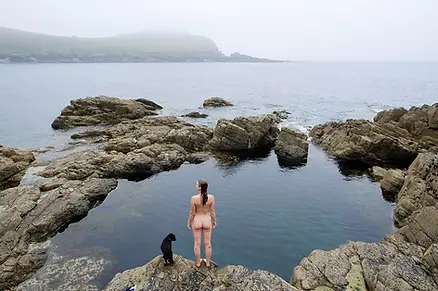
Laura went on to explain to me the attraction of tidal pools:
“Tidal pools, for me, offer peace and privacy. I'm drawn to off the beaten track swim spots that feel a world away from the crowds and, more often than not, you have the pool totally to yourself. On a choppy day they often offer a tranquil swimming spot alongside the sea so you don't have to forgo a swim.”

Laura continues: “There's a certain magic about them being revealed and then engulfed by the tide twice a day - they have a seductive beauty, almost like gems set into the cliff when viewed from a distance.”

The steps leading down to the Avarack pools have worn away after years of storms, and the main pool now only has a couple of feet of water in it, as one of the man-made walls making the pool water-tight has crumbled away.
It should be noted that these pools or others like them can contain hidden hazards.
No shirts, no shorts ... lots of service!

Eddie Matz
Oct 6, 2009, 05:15 PM ET
This column appears in the October 19
Body Issue of ESPN The Magazine.
The meal is just plain awkward. On a gray September Friday, we sit in a western Pennsylvania pizzeria, sharing appetizers and uncomfortable conversation. A bartender, a trainer, a teacher, a college kid and a couple of hack writers -- six disparate souls with little in common except the dawning reality of what is about to come. We are the Breakfast Club, only this is dinner.
"Anybody wanna split that stuffed mushroom?"
"Anybody know where the bathroom is?"
"Anybody ever done this before?"
Not hardly.
A couple of months earlier, one of my editors had called with an assignment. He told me about a wildly competitive volleyball tournament held each September not too far from Pittsburgh at a resort called the White Thorn Lodge. The event has been luring quality athletes from all over the country for 39 years: D1 players, national team members. The comp is of such a high caliber, they call it the Super Bowl of Volleyball. "Anyway," he said, "we want you and Struby to round up a team and write about playing in the thing." (Struby is fellow Mag writer Tim Struby, whom I'd met a few times but knew nothing about other than that he's more than a half-foot shorter than me, used to model and didn't seem the volleyball type.)
"Sweet," I replied. "Sign me up."
"One more thing," the editor said. "White Thorn is a nudist lodge."
Legend has it that nearly 3,000 years ago, a Greek runner named Orsippus won an Olympic race after losing his loincloth. And now I'm being asked to follow his lead, to proudly continue the legitimate if under-the-radar tradition of nude competition. Now, I may never have had a proper nudist experience, but I will admit to being a bit of an exhibitionist. I spent the first couple of years after college working at a Club Med resort, where I was approximately 8 percent clothed during the day -- and even less so at night. But finding four others who are both good at volleyball and willing to take nudism for a spin -- in front of millions of readers, no less -- seemed a nearly impossible task. Making it harder still was a mandate from The Mag to field two female pros (for gender equity's sake).
Against all odds, though, Struby came through, landing a pair of blonde bombers, Carol Hamilton and Michele Rauter, who played at Cal State Dominguez Hills and Wyoming, respectively, before going pro in Europe. Born in Long Beach and raised in San Diego, where she tends bar in the off-season, Carol is no stranger to public nudity, having been more than once to the world-famous Black's Beach in La Jolla. "I've always been very comfortable with my body," says the 6'2" lefty. Ditto Michele, a 5'9" native of Vancouver, B.C., who doubles as a personal trainer and tells me that visiting a nudist camp is on her bucket list.
Pros in pocket, I filled the fifth slot with a friend of a friend: Noah Kaiser, a free-spirited teacher from LA who played outside hitter at Westchester High, looks like Lenny Kravitz and is always down for anything. The final golden ticket went to a friend of a friend of a friend of a friend named Greg Hunter. Greg is a newly-graduated Rutgers setter who spent the summer playing the East Coast beach circuit in a Speedo. Add yours truly, a former regular at the famed Rosecrans courts of Manhattan Beach, and we are a roster of gamers.
I've worked out like a fiend for the two months leading up to the event, so I have no fear of what lies ahead. No inhibitions at all. Or so I think, right up until we get back in our RVs after our get-to-know-you dinner. As we rumble in tandem along State Line Road near Beaver Falls on Friday night, just minutes from our destination, my head suddenly swims with doubts. Exactly when will we have to get naked? Did I work out enough? Should I have trimmed down there? Should I have tanned? Will anyone notice the cluster of freckles on my right butt cheek that looks like a chocolate chip cookie? Will anyone not? Is it too late to get implants?
I'm not the only one with issues either. Carol has her period. Michele has ingrowns from her Brazilian wax. Noah frets about not being circumcised. Greg? He's stressed about having broken up with his college girlfriend the day before. And Tim? Well, he's anxious about playing a sport he doesn't really know how to play.
When we drive through White Thorn's front gate, all of our concerns disappear, replaced by sheer and utter disbelief. An elderly man carrying a clipboard approaches on the driver's side. He wears one of those Day-Glo orange vests that are popular with parking attendant types -- and nothing else. I can't help but gawk at his manhood. Not surprisingly, it looks like every other one I've ever seen. Next to him stands a stout woman with short gray hair. She's in jeans and a burgundy flannel shirt, unbuttoned halfway to reveal two bronzed, sagging breasts in their entirety (I swear I've seen her on HBO's Real Sex). Jeans and a flannel? Yes, it is unseasonably cool for the last week of summer -- temps are in the low 60s -- but still. "We're nudists," the woman says, "but we're not stupid."
Through the trees to the right is a view unlike anything any of us has ever seen: a swirl of naked bodies and volleyball nets, sprinkled with bobbing white balls. It's like one of those computergenerated movie scenes in which the hero lands on another planet and stumbles upon a mass congregation of inhabitants praying to a different god. Or performing some unknown ritual. Or playing nude volleyball. We are in another world.
The planet Naked.
The camp was founded in 1961, back when there was an actual naked volleyball association called the Tri State League, made up of real-deal squads from Penn Sylvan (Pa.), Sunny Heights, (N.J.) and Pine Tree (Md.). The league led to White Thorn's hosting of the inaugural Super Bowl, in 1971. What started with five squads is now a 70-team event. Whatever we might think about naked sports, this is serious naked sports.
We've arrived just in time for the opening ceremony. The evening is crisp, but that doesn't stop the two flag-bearers from performing their duties in full glory. Nor does it stop last year's champions from parading around the clubhouse lawn in nothing but socks and shoes. The team goes by the name Tiki Tomba, and its members look less like nudists and more like athletes. "I thought the volleyball was going to be crappy," says Carol, eyes wide with shock. "But these guys look like players." We find out later that almost all the Tiki Tombas were on the East Stroudsburg University volleyball team.
From the moment we rolled into camp and noticed that the weather had put the clothing back in clothing-optional, we expected not to have to get naked until our match the next morning (Rule No. 1: If you're playing, you're naked). We also expected to be able to practice some before having to show off our goods, so to speak.
But when the opening ceremony wraps, the White Thorn brass asks us to take the court. We've requested a spot in the all-male AA level, the tourney's highest division, but given our estrogen-laced roster, the powers-that-be are dubious that we'll be able to hang with the Tiki Tombas of their world. They're afraid someone will get hurt, maybe take a 110 mph heater square in the face. I tell them these women are pros; if anybody's going to get hurt, it sure as heck won't be one of them. In any case, they want us to face the music. I feel like a pole dancer on amateur night.
Sensing we'll chicken out, a topless woman, who had been warming up with others on the other side of the court, crosses under the net, introduces herself and cajoles us into huddling up with her. "We've been dying for you ESPN guys to come," she says. "See all those people? They want to see a game. Just one, just for fun." Then she turns to Carol, who's dressed in sweats and a tank top, and yanks off her shirt. Game on.
Turns out, White Thorn has had trouble keeping the participation of a certain national sports magazine a secret. As we stand beneath an inky sky on the green asphalt of Court 1 -- White Thorn boasts 11 outdoor courts -- the buzz of the lights gives way to the buzz of spectators. Hundreds of bodies that moments earlier weren't there line each side of the playing area. Many are clad (they're nudists, not stupid) and curious. "We're on a stage," says Michele. "Everyone is waiting to judge us."
We end up playing not one but two games, in varying degrees of nakedness. Noah, who had conquered his demons as soon as we parked the RVs, plays completely naked. Greg wears shorts. Carol is half-clothed, Michele fully so. "It was freaking cold," she says later. "Plus, I was too concerned with playing well." So am I, which is why I keep my T-shirt and shorts on. But during the first game, all I can think about is an insight shared by a White Thorn vet: When you're around a bunch of naked people and you're the one wearing clothes, you feel like an idiot.
By game's end (we lost), I realize he's right. And as I shed my threads for the second game, I'm not as concerned about how my body looks as I am obsessed by the sight of my underpants. When you anticipate that your skivvies will be on display -- maybe you're headed out for a romantic dinner, or maybe you're Soulja Boy -- you dress accordingly. Preparing for a naked volleyball game isn't one of those times. I hastily yank off my shorts and sagging, moth-eaten daddy briefs in one fell swoop. Out on the court, readying myself for the start of play, I quickly realize how exposed my backside feels. The serve receive position is similar to the classic ready stance of most sports: wide base, knees bent, butt sticking out. Mind you, I'm in the back row, which puts my keister that much closer to the watchers. You know the gem about the sun not shining on a specific spot of the human anatomy? It holds true for me, but only because it's night.
Struby, after surveying the talent on the court, decides to stay on the sideline on account of the whole bump-set-spike thing, although he's not exactly heartbroken about missing the whole nudity thing. "I have no problem getting naked," he says, "but I want to do it when I want to do it, not because everyone else is doing it." Luckily, Ian, a White Thorn regular, is willing to take Tim's spot for the weekend, and Ian has no issue with being au naturel -- not now, not ever. Feeling pretty good, we win the second game.
On Saturday morning, the only thing that has changed is the sky, which has brightened all the way to a deep gray. It is still chilly, and we are still on another planet. Dozens of angular, naked bodies have already flooded the courts to practice. Then there's us, the Breakfast Club, on Court 1, doing hitting lines, fully clothed. "None of us is ready to get naked," says Michele. But by the time the ref (naked) blows the first whistle, we're all rocking birthday suits. As it turns out, it's not unlike rocking a new pair of prescription glasses. At first we're very conscious of the difference, but before long we don't even notice. Everyone else is doing what we're doing, so by definition, it's normal. And playing a very high level of volleyball, we all get caught up in the game. "At first I felt unprotected," Carol says later. "Like, just because I had my clothes off I was going to get hit in the crotch. But after about five minutes, I totally forgot I was naked." Between points is a different story. "That's when I noticed everything," says Michele. "I thought my boobs would hurt from bouncing around, but during the game I didn't even feel them. The only time they bothered me was between plays." What bothers me between plays is not knowing how to interact with my teammates.
Part of what makes volleyball a great nudist pastime is that the game itself requires no physical contact. Problem is, no sport features more high-fiving and ass-smacking than six-on-six volleyball. Every single point is a slap-and-tickle fest waiting to happen. When you're clothed, that is. When you're naked, slapping and tickling doesn't come so easily.
But winning overcomes everything, even on planet Naked. Especially on planet Naked. In its all-out party environment, winning is the drug that shatters the ice. In each of our first four games of Saturday's pool play -- all close losses -- our interpoint interaction never goes beyond mild high fives and the occasional fist pound. Although we're comfortable in our own bare skins, a collective self-consciousness infects our side of the net. But in our fifth game, a miraculous, come-from-behind win against a stacked team we have no business beating, all propriety gives way. We are the Ohio State Buckeyes, only instead of stickers on our helmets we have handprints on our butts. Greg, riding a mix of ample rumpus and inspired play, is by far the most decorated among us.
We don't win again, and we'll be eliminated in the first round of Sunday's playoffs, but it doesn't matter. We've gone from strangers who barely know each other to friends who know each other barely. Even Tim gets in on the action. Late Saturday, with another throng watching our final pool-play match (our women make us the Michelle Wie of White Thorn; everywhere we go, a gallery follows), Tim pops up from the sideline, strips down and subs in for a single play so he'll be eligible for the playoffs, just in case. "Until then he was an outcast," says Michele. "After that, he was one of us."
The meal is just plain easy. On a golden Sunday afternoon, hours after our final match, we sit and share roasted corn and belly laughs. A bartender, a trainer, a teacher, a college kid and a couple hack writers. Thrown together by the nudity gods, we are six kindred spirits.
"Can't believe we won only one game."
"Can't believe the handprints on your ass are still there."
"Can't wait to come back next year."
Eddie Matz is a senior writer at ESPN The Magazine.
A punch in Colchester, a moral panic in London
How one attack has ironically become ammunition in Britain’s latest fight over public nudity

Dec 31, 2025
Researcher writing about nudity, history, nudism, and culture. Director at Western Nudist Research Library. Host of Naked Age and cohost of New Nudist Podcast. Grandson of Rudolph Johnson (pictured). Freehiker & father. He/him.

Video still from the Colchester World Naked Bike Ride assault | Source: Prosecutors’ footage (via news reports)
Organizers of the London World Naked Bike Ride are navigating heightened scrutiny and rising operational pressures following a wave of backlash triggered by a violent assault on a nude cyclist in August—an escalation that demonstrates how quickly public nudity is becoming a flashpoint rather than a protected form of protest. That backlash does not reflect how most Londoners experience the ride, which organizers say has long been met with curiosity, humor, and broad public tolerance, but rather how easily a single incident can be weaponized once media and political attention fixates on it.
The changes come after Robert Brown, 59, a participant in the Colchester World Naked Bike Ride, was punched off his bike by a passing motorcyclist, a local sanitation worker who later said he mistook the rider for a “pervert.”1 The cyclist suffered lasting injuries. The attacker received a suspended prison sentence.
What followed was not a renewed focus on vigilante violence as the victim might have hoped for, but a reframing of the incident itself. In the weeks after the assault, tabloid coverage, talk radio segments, and online campaigns began treating naked bike rides as the underlying problem, and putting the victim of the initial crime in a position to have to publicly defend himself accusations that he is a “pervert.”2 A petition calling for the London ride to be banned circulated online, framed around “safeguarding” and child protection—even though no laws were broken and no children were involved in the incident whatsoever.
This is the story Planet Nude readers will likely recognize: a real incident, a moral panic layered on top of it, and a familiar conclusion. Restrict the bodies that are easiest to police while ignoring the real problem.
The UK’s nudity literacy problem
Initial reporting focused, understandably, on the violence. Footage released by prosecutors showed the moment of the punch, and coverage emphasized the shock of seeing a nude cyclist attacked in broad daylight. But as the clip circulated, the frame subtly changed; the cyclist’s nudity became the headline hook, the assault itself merely a backdrop. Campaigners opposing the rides argued that events like the World Naked Bike Ride blur legal boundaries, normalize indecency, and place children at risk. Emma-Jane Taylor, a child safety campaigner who launched a petition to ban the London ride, described the events as unsafe and inappropriate. Several politicians echoed the sentiment, referring to riders as “flashers on bikes” and characterizing the rides as a failure to maintain public order.3

Emma-Jane Taylor | The child-protection campaigner behind a petition to ban the London World Naked Bike Ride has argued the events “allow perverts to be seen,” framing the issue as safeguarding | Photo: Supplied (via Daily Mail)
What went largely unexamined was the legal reality. The rides are lawful, coordinated with police, marshalled by volunteers, and governed by strict codes of conduct. Nor did much coverage linger on the uncomfortable implication of the proposed solution: that when someone reacts violently to a lawful protest, the protest—not the violence—should be curtailed.
Part of what allows this inversion to take hold is a persistent lack of public understanding about the law around nudity in England and Wales. Public nudity is not, in itself, a sexual offense. Under the Sexual Offences Act 2003, context and intent are decisive in cases involving nudity, which becomes criminal only when it is lewd, sexual, or intended to cause harassment, alarm, or distress—not when it is part of a peaceful protest or everyday activity.
British Naturism (BN), which has spent decades engaging with police forces, councils, and public authorities, says this misunderstanding is widespread. “Many people assume that being naked in public must be illegal,” Mark Bass of British Naturism told Planet Nude. “This belief often arises not from the law itself, but from unfamiliarity. When something is rarely encountered, it’s easy to conclude there must be something inherently wrong with it.”
Addressing that unfamiliarity has become a central focus of BN’s public-facing work. In recent years, the organization has increasingly turned to direct public education efforts, including its The Naked Truth campaign, which aims to clearly explain what UK law does—and does not—say about non-sexual public nudity. The campaign distills complex legal guidance into accessible language, countering the assumption that nudity is automatically indecent or unlawful.
BN’s engagement has also shaped how the law is applied in practice. According to Bass, guidance from the Crown Prosecution Service and the College of Policing on how officers should respond to reports of public nudity has directly benefitted from BN’s input. “This has never been about seeking special exemptions for naturists,” he said. “It’s about helping authorities avoid unintended consequences and ensuring laws are applied fairly and sensibly.”
That distinction matters. British Naturism does not organize World Naked Bike Rides, which are protest actions rather than club naturism. But the principle that lawful nudity should not be treated as inherently suspicious is a shared concern.
Bass also cautions that the backlash may say less about nudity itself than about a broader shift in social behavior. “Ten years ago, people who disapproved might have tutted, rolled their eyes, or complained to friends,” he said. “Today, reactions to things people dislike have become more extreme. Opposition increasingly turns aggressive.” In that climate, ambiguity becomes dangerous. When the public is unclear about what the law permits, and media coverage leans into outrage rather than explanation, escalation becomes easier to justify.
“Think of the children,” again
Perhaps the most predictable element of the backlash is the invocation of children. Opponents of the rides consistently frame their objections around safeguarding, even when children are not directly involved. In the Colchester case, no minors were present. No allegations of harm were made. Still, campaigners quickly shifted the focus away from the assault itself and toward speculative risk.
The logic is familiar: not that something did happen, but that something could happen. That possibility, once raised, is treated as sufficient justification for bans, restrictions, or heightened control. The burden of proof quietly reverses. Organizers and participants are asked to demonstrate that harm will never occur, rather than critics being asked to show that it has.
Planet Nude readers have seen this pattern before. In Wisconsin, a nearly identical strategy was deployed against World Naked Bike Rides in 2023.4 There, outrage centered on the presence of a single minor participant at the Madison ride—accompanied by a parent, at a clothing-optional, city-sanctioned protest. Conservative media coverage framed the child’s participation as inherently exploitative. Republican lawmakers seized on the controversy to introduce bills that would have criminalized public nudity outright and prohibited minors from attending events where adults might be nude. Law enforcement had investigated and found no violations of state or local law. The child involved reported no harm and expressed enthusiasm about the experience. None of that slowed the political response. The bills advanced anyway, driven less by evidence than by the optics of “protecting children” from a perceived moral threat.5

Robert Brown stands with his bicycle in Colchester, Essex | Brown, who was assaulted during a World Naked Bike Ride event in August, has publicly rejected claims that naturist cycling is “perverted” and has defended the legality of non-sexual public nudity | Photo: Daily Mail
What’s notable is how little these debates hinge on facts once the safeguarding frame is activated. In both London and Wisconsin, child protection functioned as a rhetorical trump card—an argument that effectively shuts down discussion by casting disagreement as indifference to child harm. It is a powerful move because it bypasses proportionality and triggers deep emotions. If children are invoked, nuance becomes suspect. Legal context becomes secondary. Intent no longer matters.
The remedies proposed under this framing are rarely narrow or surgical. They are sweeping and punitive, aimed not at specific conduct but at entire categories of expression. In Wisconsin, lawmakers sought to rewrite indecent exposure law altogether. In the UK, campaigners have called for outright bans on naked bike rides, despite their legality and long history of peaceful operation.
In both cases, the underlying assumption is the same: that nudity itself is the danger. Once that premise is accepted, violence against nude bodies can be rationalized as provocation, and restrictions on lawful protest can be framed as prevention. That is not safeguarding. It is moral panic, dressed in the language of concern.
The pressure reshapes the protest
As of this writing, the consequences of the moral panic have become visible. Last week, organizers of the London World Naked Bike Ride have reportedly hired additional security for next year’s ride, and adjusted route plans to reduce friction.6
Bass argues that the response to this moment will shape what comes next. “Naturism is rooted in respect, empathy, and kindness,” he said. “Calm, measured responses aren’t always easy when emotions are running high, but striking back only deepens division. If we want to reduce hostility rather than amplify it, respectful engagement is essential.”
Stripped of tabloid story-framing, the question isn’t whether everyone likes naked bike rides, or even whether nudity is inherently lewd or not. It’s whether lawful protest can survive a climate where discomfort is treated as danger, and danger is treated as license. The cyclist in Colchester did nothing illegal. He was assaulted for being visible. How Britain responds to that fact will say far more about the state of public freedom than any petition ever could. 🪐
Updated 12/31 at 11:00 a.m. PST: This article was updated to clarify the use of “panic” along with factual details around the petition, event planning decisions, and the distinction between media backlash and on-the-ground public response.
Family Naturism
It's Complicated
By Genisouls

Dec 29, 2025

I am a writer and artist traveling the world seeking beauty and truth
The greatest irony of nudism is that those against it use exactly the same reason as the people for it-- “There are kids around!” The same argument used against nudists is used by nudists to justify the practice.
How often have we’ve been minding our own business, strolling along an empty beach, dressed as God intended, when we hear a clothed lunatic in the distance screaming, “Put some clothes on, there might be kids around”? It happens all the time. The clothing world wants us to think there’s something obscene about nudism so they casually and gratuitously throw in the possibility that children would be harmed by seeing a naked human. There isn’t a kid within miles, but that doesn’t stop these Bay Watch moralists from accepting the worldview of a child-- a view imagined out of whole cloth anyway.
On the other side of the spectrum, those who want nudism to appear wholesome and harmless bring kids into the picture to legitimize it. How can it be bad if loving families are involved? Kids don’t see nakedness, they’re not corrupted yet. It’s innocent and good fun, probably beneficial to their self-esteem, promoting healthy views of their body. As parents we wouldn’t let it be bad, there’s no sex here, because, as you can see, there are kids around. We all just play and enjoy family activities, no adult stuff at all, G-rated all the way.
Kids remain the issue that dog's nudism.
Being natural and matter of fact about nudity prevents your children from developing an attitude of shame or disgust about the human body. If parents are very secretive about their bodies and go to great lengths to prevent their children from ever seeing a buttock or breast, children will wonder what is so unusual, and even alarming, about human nudity. —Dr. Lee Salk, psychiatrist
It’s hard to be surrounded by family without experiencing nudity. Besides the raising of children and the bathing and changing, there is the inadvertent nudity-- family members walking in on each other, parents coming home earlier than expected from work. In the Medieval Age, families lived in cramped one room huts where family nudity was part of life. Extended families lived in Viking Longhouses, maybe that’s why Scandinavians aren’t particularly disturbed by nudity. Family nudity is common with those living in the natural world. In places like the Amazon or New Guinea, family members who prefer loin cloths can be grounds for seeking a head shrink.
I grew up walking around naked in my house. My mom was like that, and my sisters. —Jennifer Lopez
I’m a nudist, yet I don’t practice nudism around my family. On the opposite spectrum, there are people who don’t consider themselves nudists who don’t blink an eye at nakedness within the family. Family nudity is complicated— how to raise children and instill values can be a source of many arguments. It can be a big issue for couples— there can be a lot of friction when one person is a nudist but their partner isn’t. Undoubtedly, there are families where everyone is a nudist but no one ever admits it, happy to pursue nudism with their new friends while preferring to keep their closest relations out of it. While almost every family member has skinny-dipped or Godiva-cycled through town at midnight, it’s usually a closely-held secret. Shame of nakedness runs through families like any normal dysfunction.
Nudity is complex, we’re dealing with the reaction of society, neighbors, and relatives all in the context of state control with a police state monitoring every move we make. The assault on nudism can be like a steady blowtorch to our soul, which we can try and ignore, but have to constantly confront. No one likes to be labeled and grouped with the worst people, and those harming children top the list, which is why it’s so irresponsible to use children as an attack against nudists.
I have nothing against family naturism, but I’m not going to initiate it-- too many arguments to make, too many mental barriers to overcome, especially at this stage of my life. I realize my hang up is my hangup. As I’ve grown older, I’ve had to take care of aging parents and nudity has become more common. Still, family naturism remains a foreign concept to me.
The problem, as I see it, is that even if nudity is accepted within the family, it doesn’t mean that society will accept it. Society is the ultimate bulldozer when it comes to personality development— and it doesn’t like nudity. A family’s nudism is usually kept secret at the risk of developing the reputation of a family of weirdos. Imagine the conflict this has on a child? Told one thing at home and then going out into the world and finding the thing the child loves and thinks is normal is a source of shame and humiliation. Some, like Jennifer Lopez, will ignore all the noise and continue with nudism, but others will awaken in the future, appalled at how they were raised. They might seek therapy and develop elaborate tales of a broken childhood’s, usually with a clothed therapist nodding along at the trauma. Until society develops and can see the naked human body in a positive way, nudist parents will have to deal with these major issues, because their kids are the ones who have to live with this reality.
Are children harmed by nudity? My worldview is based on my life as a kid. Growing up, I loved seeing naked people and only wished everyone was naked. The idea of being harmed by seeing boobs and dicks continues to make me laugh. In fact, despite the prohibition of adult nudity, I saw plenty of naked people growing up-- adult men peeing around stadium urinals, showers at the gym, naked women in magazines-- being harmed never occurred to me. In my experience, kids generally seek nudity out, it’s a natural part of maturing. Girls undress their Barbies, teenage boys drill holes in gym showers. The harm isn’t in normal nudity, it’s in criminal nudity, the flasher jumping out of the bushes at the park, not nudists laying on the beach or surfing naked at Pipeline. Kids get it, it’s oftentimes the adults raising them who have it all wrong (including me).